
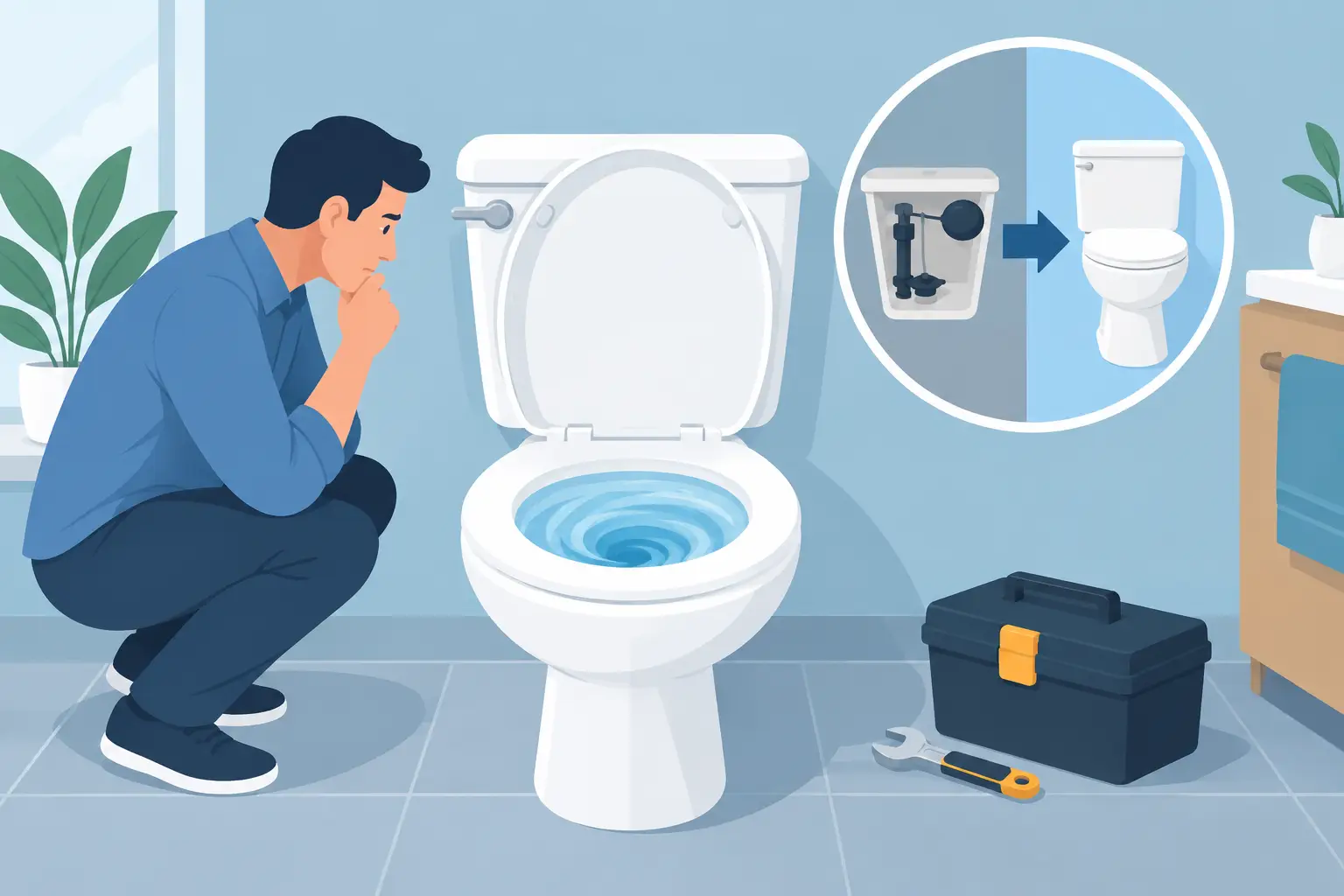
A toilet that suddenly needs a second flush, leaves water climbing high in the bowl, or runs long after you leave the bathroom is more than an annoyance. Toilet flushing problems can be caused by a simple worn part, but they can also be the first clear sign that the fixture itself is past its useful life. For homeowners, landlords, and sellers, the practical question is not just “Can this toilet be fixed?” It is “Will another repair actually solve the problem, or am I about to spend more money on an old toilet?”
A replacement is often the better call when flushing issues come with visible age, recurring leaks, cracks, instability, or poor bowl cleaning. A newer toilet can improve flushing performance while using less water, and it removes the uncertainty of keeping an aging fixture in service.
What Toilet Flushing Problems Usually Mean
Not every weak flush means the toilet needs to be replaced. Sometimes the problem is localized: the tank is not filling to the proper level, the flapper is not opening fully, or mineral buildup is restricting the small rinse holes beneath the bowl rim. Those issues can reduce the force of the flush even if the toilet itself is still in good condition.
The bigger concern is a pattern. If the toilet clogs regularly despite normal use, needs frequent plunging, leaves waste behind after a flush, or has been repaired several times already, the fixture may simply have an outdated or failing flushing design. Older low-flow toilets are a common example. Some early water-saving models used less water without providing enough bowl wash or trapway performance, so they earned a reputation for weak, frustrating flushes.
A toilet can also appear to flush poorly when the real issue is that it has developed wear around the base, tank, or internal components. You may notice a slow leak at the floor, a tank that rocks against the wall, or water that keeps moving in the bowl long after flushing. Those are not details to ignore. Water at the base can damage flooring, subflooring, and ceilings below the bathroom if it goes unnoticed.
Signs Replacement Makes More Sense Than Another Fix
A toilet does not need to be completely unusable before replacement becomes the sensible option. In homes throughout Fairfax County, Loudoun County, and Northern Virginia, we often see toilets that technically still work but have reached the point where owners are tired of managing them.
Cracks are the clearest reason to replace. A hairline crack in the porcelain tank may start as occasional moisture on the outside, while a crack in the bowl or near the base can lead to a more serious leak. Porcelain cannot be reliably repaired for long-term use. If the fixture is cracked, replacement is the safe move.
A toilet that rocks when someone sits down should also be taken seriously. It may be caused by an uneven floor, loose mounting hardware, or a failed seal beneath the toilet. The concern is not just comfort. Movement can compromise the connection at the drain and allow water to escape below the fixture.
Consider replacement when you are dealing with several of these issues at once:
- Frequent clogging or repeated double flushing
- A persistent running sound or unexplained water use
- Leaks around the base or visible corrosion on old hardware
- Staining, rough porcelain, or a bowl that never seems clean
- An outdated height or shape that is uncomfortable for the household
One repair on a relatively new, otherwise dependable toilet may be worthwhile. Multiple problems on a 15- or 20-year-old toilet are different. At that point, putting money into individual parts can become a cycle rather than a solution.
Check These Things Before You Decide
Start with what you can see and hear. Remove the tank lid carefully and flush once. The water level in the tank should be near the marked fill line, and the flapper should lift fully and then settle back into place. If the tank barely fills, the flush will be weak. If water continues to flow after the flush, the toilet may be wasting water every day.
Then look at the bowl. Does the water rise unusually high before draining? Does the bowl clear slowly? Does it clog with routine use? A slow drain can be related to a partial blockage, but recurring clogging can also be a limitation of an older toilet’s trapway and flush system.
Finally, inspect the floor around the base. A little water after a shower may be harmless condensation or splashing. Moisture that returns around the toilet base, especially after flushing, deserves attention. Dry the area, place a few sheets of toilet paper around the base, and check again after several flushes. If the paper becomes damp, do not keep postponing the issue.
Why New Toilets Flush Better Without Using More Water
A modern toilet does not need a huge tank to provide a dependable flush. Better bowl geometry, larger trapways, improved siphon action, and more effective rim wash have changed what a water-efficient toilet can do. Many current models use 1.28 gallons per flush, compared with the 3.5 gallons or more used by many older fixtures.
That does not mean every new toilet performs the same. The least expensive fixture is not always the best choice for a busy family bathroom, a rental property, or a home where the toilet gets heavy daily use. Bowl shape, flush design, height, and internal component quality all matter.
For example, a round-front toilet can save space in a tight powder room, while an elongated bowl generally feels more comfortable in a primary or hall bathroom. Comfort-height toilets sit a little taller than traditional models and are often easier for adults, older residents, and anyone with knee or mobility concerns. A standard-height toilet may still be a better fit for a bathroom used regularly by young children.
Skirted designs are another practical upgrade. They conceal the trapway on the sides of the toilet, so there are fewer hard-to-reach curves where dust and grime collect. They cost more than many conventional exposed-trapway models, but homeowners often appreciate the easier cleaning and cleaner appearance.
What Replacement Actually Costs
Toilet replacement cost depends on more than the porcelain fixture. The total job should account for delivery, bringing the new toilet into the home, disconnecting and removing the old unit, installing and testing the new one, and legally disposing of the old fixture. A low retail price can look attractive until those separate steps are added up.
For a straightforward, bundled replacement, ToiletKing’s Essential options start at $499. Performance options start at $669, Signature options start at $799, and King’s Throne options start at $1,049. Specific pricing varies by toilet model and the features you choose.
The right tier depends on the property and the goal. A landlord replacing a damaged toilet between tenants may want a reliable, budget-conscious Essential option. A seller preparing a bathroom for listing may choose a clean, modern model that improves the room without overinvesting. For a long-term home, upgraded flushing, a comfort-height bowl, a skirted exterior, or bidet compatibility may be worth the higher starting price.
There can be extra considerations when the existing plumbing connection, flooring, or shutoff condition creates an installation issue. That is why a clear consultation matters. The goal is to know what you are getting before the appointment, not to discover surprise tasks after the old toilet is already removed.
A Cleaner Answer to an Ongoing Problem
When toilet flushing problems keep coming back, replacement is often less disruptive than another round of troubleshooting. A focused replacement service should arrive with the selected fixture, remove the old one, install the new toilet, test it, clean up the work area, and take the old unit away. In a typical straightforward replacement, that can be completed in under an hour.
If your toilet is leaking, cracking, rocking, clogging repeatedly, or simply no longer flushing the way it should, do not wait for it to fail at the worst possible time. Call ToiletKing at (571) 326-8708 to schedule a free consultation, and mention promo code FIVEOFF when applicable. A dependable new toilet is one of the simplest ways to make a bathroom feel functional again.