
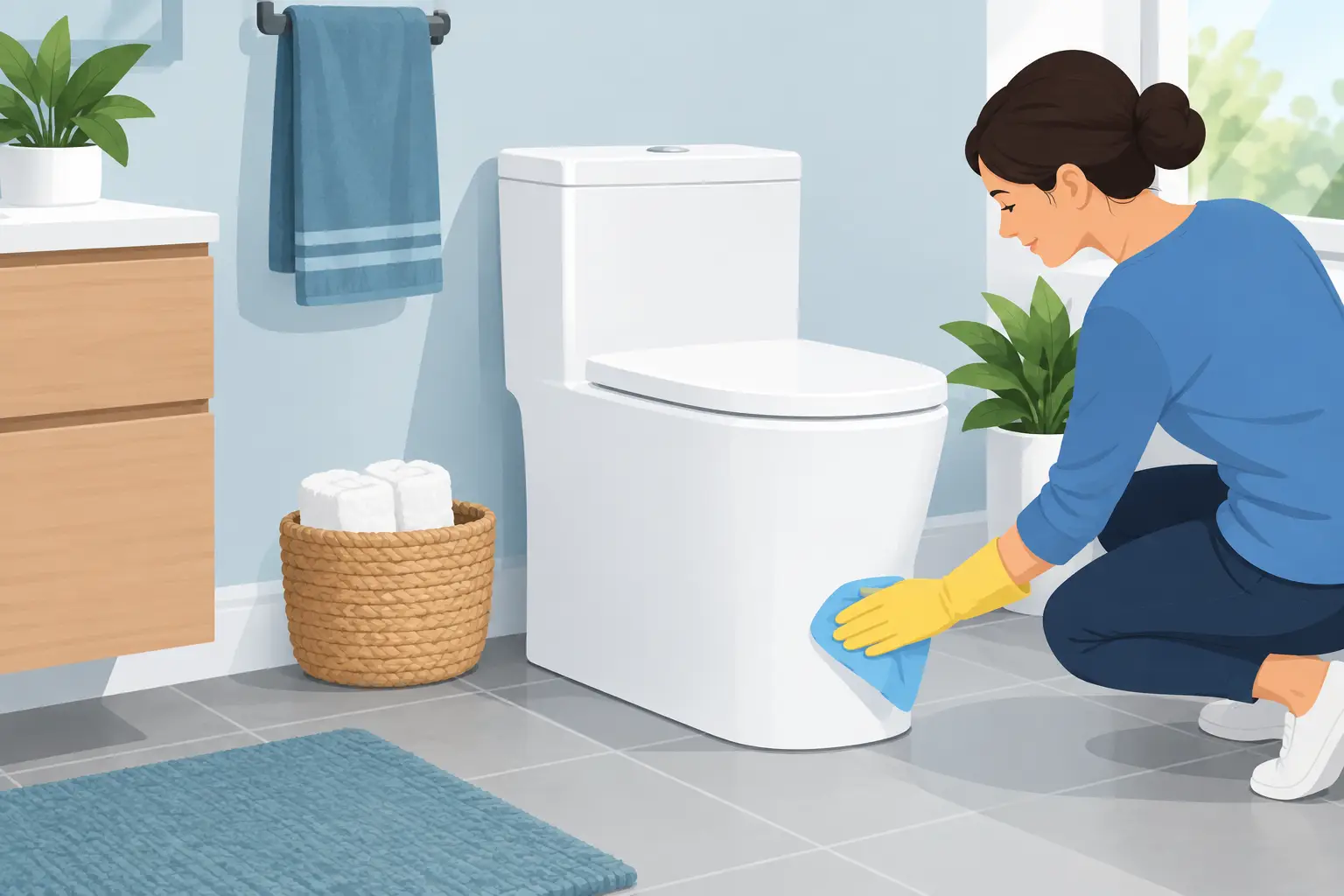
A toilet can flush perfectly and still be the worst thing in the bathroom to clean. The biggest skirted toilet cleaning benefits come from what you do not see: exposed trapway curves, bolt caps, and tight grooves that collect dust, hair, and dried cleaner residue. A skirted model covers those hard-to-reach areas with a smooth exterior, making regular bathroom cleanup faster and less frustrating.
For homeowners who are replacing an old toilet anyway, easy cleaning is a practical reason to consider a skirted design. It is not just an appearance upgrade. In a busy household, rental property, or home being prepared for sale, less time spent scrubbing behind the toilet is a real advantage.
Why skirted toilets are easier to clean
A conventional toilet has a visible, curved trapway running from the bowl toward the floor. It often has contours, seams, bolt covers, and awkward spaces near the back. Those surfaces can trap lint from towels, pet hair, dust, and the residue left by spray cleaners. Cleaning them usually means crouching beside the toilet and working around corners with a cloth, brush, or paper towel.
A skirted toilet encloses that trapway. The side of the fixture is generally smooth and straight from the bowl toward the base, with far fewer places for buildup to hide. Instead of cleaning around multiple curves, you can usually wipe the visible exterior in a few passes.
That difference matters most in bathrooms with limited space. When a toilet sits close to a vanity, wall, or bathtub, the gap behind and beside it can be difficult to access. A smooth-sided toilet does not eliminate the need to clean the floor around the base, but it removes much of the detailed work that makes conventional toilets feel grimy even after a quick clean.
Fewer crevices means less visible buildup
The exposed trapway on a standard toilet is not inherently unsanitary. It is simply harder to keep looking clean. Dust settles on horizontal ridges. Hair wraps around bolt caps. Moisture from showers can make dirt stick to textured porcelain surfaces.
With a skirted model, there are fewer ledges where that buildup can collect. This is particularly helpful in shared bathrooms, homes with pets, and rental units between tenants. A quick wipe-down is more likely to look like a complete cleaning job, rather than leaving dusty edges behind.
The base is easier to inspect
A clean toilet base also makes it easier to notice a real problem. If water is appearing around the bottom of the toilet, a smooth exterior gives you a clearer view of where the moisture is coming from. Water at the base can point to condensation, a missed aim issue, or a failing wax ring, and it should not be ignored.
A skirted toilet will not prevent leaks. What it can do is make routine inspection less complicated because there are fewer exterior shapes concealing dirt or dampness. If a toilet rocks when you sit down, has recurring water around its base, or leaves staining on the floor, replacement is often a better conversation than repeated cosmetic cleanup.
Skirted toilet cleaning benefits beyond the weekly routine
The cleaning advantage is easy to understand after the first few wipe-downs, but it also affects how a bathroom looks over time. Toilets with exposed trapways can develop a permanently dusty appearance in the grooves, especially if cleaning is rushed. Smooth-sided models tend to hold their clean, finished look longer between deeper bathroom cleanings.
For a homeowner preparing to sell, that can make a surprisingly noticeable difference. Buyers look closely at bathrooms, and an older toilet with yellowed bolt caps, stained seams, or visible grime behind the base can make the whole room feel dated. A clean, modern skirted toilet creates a more intentional look without requiring a full bathroom remodel.
For landlords and property managers, the value is similar. A fixture that is easier for a tenant to wipe down may stay in better visible condition during the lease. It also simplifies turnover cleaning, when time matters and every extra task adds labor.
What a skirted toilet does not solve
A skirted toilet is easier to clean on the outside, but it does not make the bowl self-cleaning. You will still need normal bowl cleaning, especially if the toilet has hard-water mineral deposits, a weak flush, or an old fill valve that runs intermittently. The internal components still require the same occasional attention as those in other toilets.
It is also worth knowing that some skirted models require access through the top or side for installation and future service. That is normal, but it can make an inexperienced installation more complicated than a basic exposed-trapway toilet. Proper alignment, a stable base, and secure connections matter just as much as the clean exterior.
The other trade-off is price. Skirted toilets often cost more than comparable traditional designs because of their styling and construction. If you are replacing a toilet in a lightly used basement bathroom or a budget-focused rental, a conventional model may be the sensible choice. The best toilet is the one that fits the room, the household, and the reason you are replacing it.
Choosing the right skirted toilet for your bathroom
Start with fit, not looks alone. Measure the rough-in distance from the finished wall behind the toilet to the center of the floor drain bolts. In many homes, this is 12 inches, but older homes can vary. You also need to consider the clearance in front of the bowl, the location of the shutoff valve, and whether the bathroom door can open comfortably with a longer elongated bowl.
Comfort height is another decision. A comfort-height toilet sits a little taller than a standard-height model and can be easier for many adults, older family members, and taller users to stand from. Standard height may feel more comfortable for young children or shorter users. Skirted toilets are available in both styles, so the cleaning benefit does not require compromising on seat height.
Flush performance matters too. A toilet that looks easy to clean but needs a second flush or clogs frequently will not feel like an upgrade. Brands such as Kohler, American Standard, and TOTO offer skirted options with different bowl shapes, flushing systems, and water-use ratings. The right choice depends on your household’s needs and the dimensions of the existing bathroom.
When replacement makes more sense than another deep clean
Sometimes cleaning reveals that the issue is bigger than dirt. Fine cracks in the porcelain, recurring clogs, a tank that sweats constantly, a toilet that shifts at the floor, or a flush that has become noticeably weak are all signs to take seriously. Older toilets may also use significantly more water per flush than current high-efficiency models.
If you are replacing an outdated fixture in Fairfax County, Loudoun County, or elsewhere in Northern Virginia, a skirted design is worth comparing while the old toilet is already coming out. It is much easier to choose the shape, height, and finish you want during a planned replacement than to live with a hard-to-clean toilet for another decade.
ToiletKing offers complete toilet replacement with delivery, removal, installation, and legal disposal of the old fixture. Options range from Essential packages starting at $499 to Performance, Signature, and King’s Throne selections starting at $669, $799, and $1,049 respectively, depending on the specific model. Many replacements are completed in under an hour, so you do not have to coordinate a retailer, delivery crew, installer, and disposal service separately.
A skirted toilet will not make bathroom cleaning disappear, but it can remove one of the most annoying parts of the job: scrubbing around a maze of porcelain curves. If you want help selecting a toilet that is easier to clean and right for your space, call ToiletKing at (571) 326-8708 or book a free consultation at ToiletKingVA.com. Use promo code FIVEOFF where applicable, and choose a fixture that makes the next cleanup a little easier.