
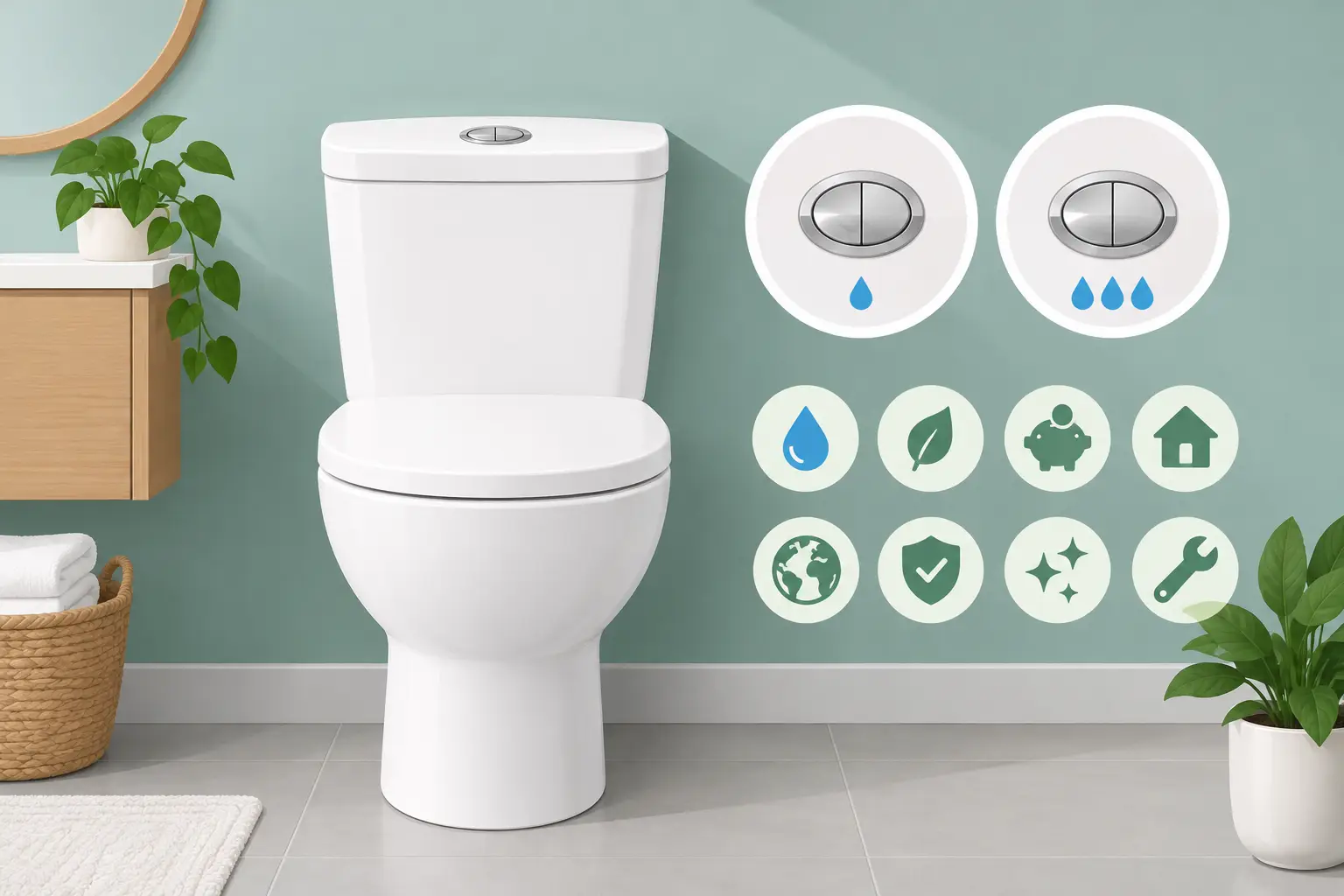
A toilet that works perfectly can still waste thousands of gallons a year. That is the practical reason dual flush toilet benefits get so much attention from homeowners, landlords, and sellers: the toilet gives you a smaller flush for liquid waste and a full flush when the bowl needs more clearing power. You use the water the job calls for instead of sending the same large volume down the drain every time.
For many homes in Fairfax County, Loudoun County, and the Washington, DC area, a dual flush toilet makes the most sense when an older 3.5-gallon or 1.6-gallon fixture is already due for replacement. It is not automatically the right choice for every bathroom, but a good-quality model can lower water use without asking your household to accept weak flushing or repeated flushes.
What Is a Dual Flush Toilet?
A dual flush toilet has two flush settings. The reduced flush, commonly 0.8 or 1.0 gallons per flush, is intended for liquid waste. The full flush, often 1.28 or 1.6 gallons, handles solid waste. Depending on the model, you select the setting with two buttons on the tank lid or a split flush lever.
The idea is simple, but the hardware matters. On a well-designed toilet, the flush valve, trapway, bowl rinse, and refill setting work together. The small flush needs to clear the bowl reliably, while the full flush needs enough force to move waste through the trapway without leaving streaks, splashing, or requiring a second try.
The Most Meaningful Dual Flush Toilet Benefits
Lower water use without changing household habits
The clearest benefit is water savings. A conventional older toilet uses the same amount of water whether someone is flushing tissue and liquid waste or a full bowl. A dual flush model lets a family use the lower-volume option for the majority of daily trips to the bathroom.
Actual savings depend on how many people use the bathroom, the toilet being replaced, and whether everyone uses the buttons correctly. Replacing a 3.5-gallon toilet generally creates a much bigger reduction than replacing a newer 1.28-gallon WaterSense toilet. Still, even homes with modern fixtures may appreciate using less water on the frequent reduced flushes.
A practical upgrade for high-use bathrooms
A powder room near the kitchen, a hall bathroom used by kids, and a rental unit bathroom can see a surprising number of flushes in a day. In those spaces, small savings per flush add up. For landlords and property managers, this can be especially useful where water costs are included in rent.
Dual flush toilets are also a sensible choice for a home seller updating a dated bathroom. A clean, modern toilet with a clearly labeled water-saving feature reads as a considered improvement, not just a replacement for a worn-out fixture with a faded seat and yellowing tank.
Modern designs are easier to live with
Many dual flush models are available in comfort height, elongated bowl, and skirted designs. Those features are separate from the dual-flush function, but they often come together in newer toilet lines.
Comfort height is usually easier for adults, taller users, and anyone who has trouble standing from a lower seat. An elongated bowl offers a little more room than a round-front bowl, though it projects farther into the room. Skirted toilets hide the curves and bolt areas along the base, making routine cleaning much less fussy. If you have ever tried to wipe dust from behind exposed toilet trapway contours, that difference is easy to understand.
Better control can reduce unnecessary repeat flushing
A common concern is that a water-saving toilet will be weak. That reputation came from some early low-flow designs, not every efficient toilet on the market now. A quality dual flush toilet should clear the bowl with the correct setting, not leave you holding the button down, flushing twice, or reaching for the plunger.
That is why model selection matters more than a marketing label. The cheapest dual flush unit is not necessarily the best value if its light flush leaves paper behind or its full flush is loud and inconsistent. Kohler, American Standard, and TOTO each offer options designed around different priorities, including quiet operation, bowl wash, compact footprints, and stronger waste removal.
When a Dual Flush Toilet Is Worth the Switch
A replacement is easier to justify when the current toilet is showing its age. Watch for a tank that refills on its own between uses, water around the base, hairline cracks in the porcelain, frequent clogs, a rocking bowl, or a flush that has become slow and unreliable. A toilet that needs a handle jiggle after flushing can waste water constantly, even if the leak is too quiet to notice.
A dual flush replacement can also make sense when you are renovating a bathroom, replacing mismatched fixtures, or trying to improve a rental between tenants. The best time to make a water-efficiency decision is before a failure turns into an urgent same-day purchase.
It may be less compelling if you already have a newer, reliable 1.28-gallon toilet and water use is your only concern. In that case, the additional savings may be modest. But if you also want comfort height, an easier-clean skirted base, a more attractive profile, or stronger flushing performance, the upgrade has more than one payoff.
Consider the Trade-Offs Before You Choose
Dual flush is not a magic answer for every bathroom. Two-button mechanisms have more parts than a basic single-handle setup, and a low-quality mechanism can become finicky over time. Buttons may stick, seals can wear, and replacement parts should be readily available for the specific model.
The lower setting also depends on the user. Guests and young children may press the wrong button, or may use the full flush every time. That does not hurt the toilet, but it lowers the potential savings. Clear button markings help.
Fit is another major consideration. Before selecting any toilet, measure from the wall behind the toilet to the center of the floor bolts. Most homes use a 12-inch rough-in, but 10-inch and 14-inch rough-ins exist. Also measure the available depth, especially where a door, vanity, or shower entry is close to the bowl. An elongated comfort-height toilet can be a major improvement, but not if it crowds a small powder room.
Finally, do not overlook the condition of the floor and shutoff valve. A toilet that rocks may have a failing wax ring, uneven flooring, or flange issues below the fixture. Replacing the toilet is the right moment to identify installation conditions that affect a stable, leak-free finished result.
Choosing the Right Replacement Level
For a rental, guest bath, or home heading to market, a dependable efficient toilet may be all you need. ToiletKing’s Essential options start at $499 and are built for straightforward, functional replacement needs.
For a primary bathroom or a household that cares about flushing strength and comfort, Performance options start at $669 and Signature options start at $799. Specific toilet models and bathroom conditions affect the final package price. Higher-end choices can add features such as skirted sides, refined bowl rinse, upgraded styling, or bidet compatibility.
King’s Throne options start at $1,049 for homeowners making a larger bathroom upgrade. That tier can be a better fit when looks, cleaning convenience, and premium features matter as much as water efficiency.
The useful comparison is not simply dual flush versus single flush. It is whether the specific toilet fits the room, clears well, is comfortable for the people who use it, and has a price that includes the entire replacement job.
Replacement Should Not Create a Second Project
A toilet replacement often becomes stressful because the homeowner has to buy a fixture, arrange delivery, find an installer, and figure out what to do with the old porcelain toilet. A full-service replacement avoids that chain of handoffs. The fixture is delivered, the old toilet is removed, the new one is installed and tested, and the old unit is legally disposed of.
At ToiletKing, most standard replacements are completed in under an hour. That is particularly helpful when a toilet is leaking at the base, the tank has cracked, or a rental needs to be ready for the next occupant. It also means you can choose an efficient upgrade without turning a bathroom fixture swap into an all-day project.
If you are weighing dual flush toilet benefits against the cost of replacement, start with the toilet you have now and the bathroom you want to use tomorrow. Call (571) 326-8708 or book a free consultation at ToiletKingVA.com. Use promo code FIVEOFF where applicable, and you can get a clear replacement plan before a small toilet problem becomes a flooded-bathroom problem.