
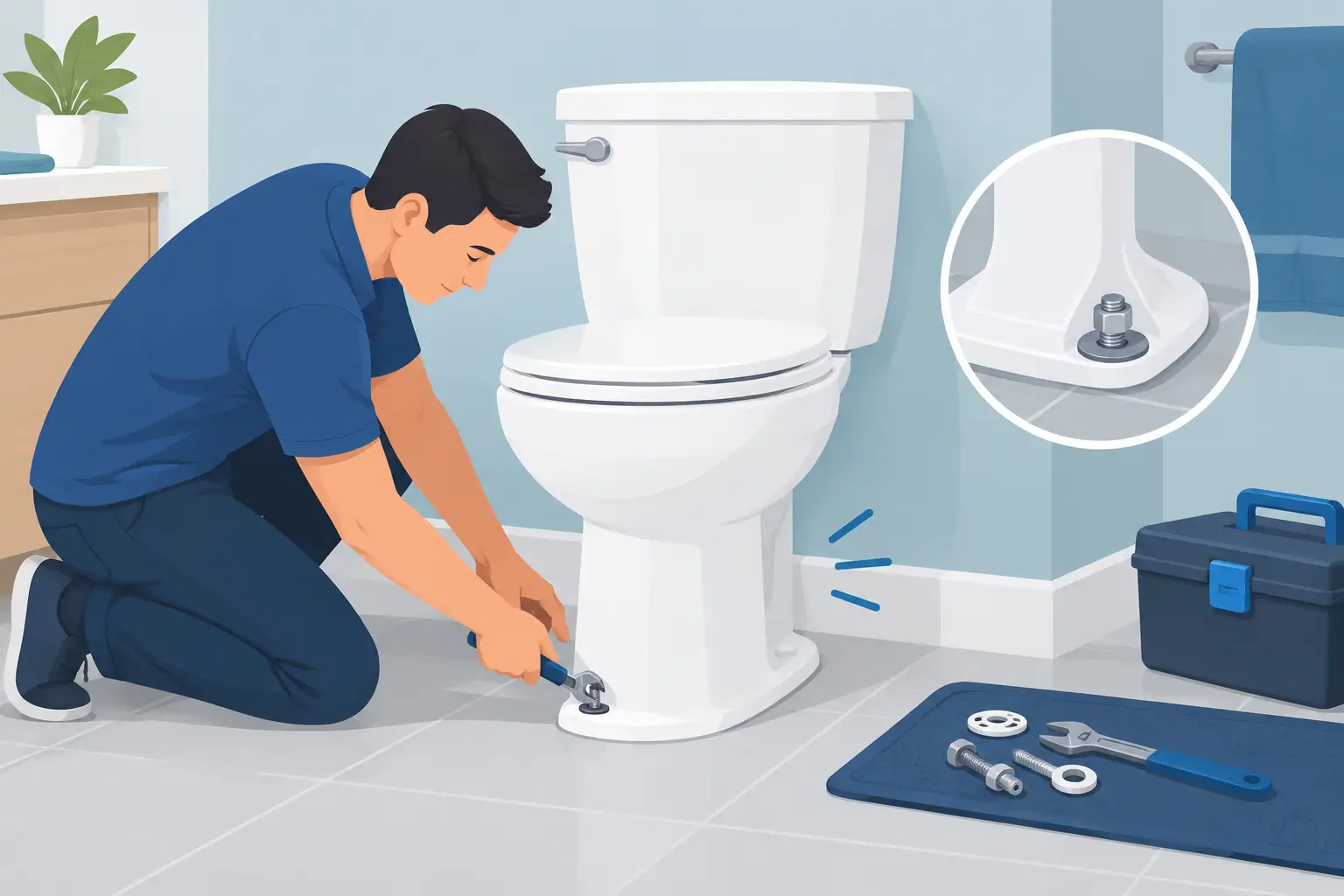
A toilet that rocks when someone sits down is more than irritating. If you need to fix toilet wobble, deal with it before repeated movement breaks the wax seal beneath the toilet. That small seal keeps sewer gas and wastewater where they belong. Once it fails, a simple loose toilet can turn into a leak, stained ceiling, damaged subfloor, or an unpleasant bathroom odor.
The good news is that a wobble does not always mean a major problem. Sometimes the floor is uneven and the toilet simply needs to be shimmed and secured correctly. Other times, the movement is telling you the toilet, flange, wax ring, or flooring has already reached the point where replacement makes more sense.
First, find out why the toilet is rocking
Start with a dry floor and an empty toilet bowl if possible. Place one hand on each side of the bowl and gently press from side to side. A toilet should feel planted. It should not click, shift, or lift at one edge.
Look closely at the base while it moves. If the toilet rocks but the floor is solid, the bowl may be sitting unevenly on tile, vinyl, or a slightly sloped bathroom floor. This is common in older homes around Fairfax County and Loudoun County, especially where new flooring was installed around an existing toilet rather than underneath it.
If the entire toilet moves and the bolts at the base are loose, the mounting hardware may be the issue. Those bolts are often called closet bolts. They connect the toilet to the flange, the fitting anchored to the floor around the drain opening. Loose bolts can sometimes be tightened, but a bolt that spins freely or will not hold may point to a damaged flange below.
Pay attention to moisture. Water around the base, a soft spot in the flooring, darkened grout, or a sewer smell changes the situation. Those signs can mean the wax ring has been compromised. Do not assume the water is harmless condensation or a missed splash if it keeps returning.
How to fix toilet wobble when the toilet is otherwise sound
For a toilet with no leak, no cracked porcelain, and a firm floor, the usual fix is to stabilize it with toilet shims and then secure the bolts carefully. Plastic toilet shims are better than wood because they will not absorb moisture, swell, or rot.
Start by locating the side that lifts when pressure is applied. Slide a plastic shim into the gap at the base until the rocking stops. Do not hammer it in hard. The goal is support, not force. A toilet bowl is porcelain, and porcelain does not give you much warning before it cracks.
Once the toilet is stable, check the closet bolts. Tighten each nut a little at a time, alternating sides so the pressure stays even. This is where many do-it-yourself attempts go wrong. Overtightening can crack the base of the toilet, often near a bolt hole, and then the entire fixture needs to be replaced.
After the toilet is stable and the bolts are snug, trim any visible portion of the plastic shim with a utility knife. Many installers apply a thin bead of bathroom-grade caulk around the front and sides of the base for a finished look. Leaving the back edge uncaulked is a practical choice because it allows a future leak to show itself instead of trapping water underneath the toilet.
Flush several times, then check the floor around the base over the next day or two. If the wobble returns, the bolts loosen again, or moisture appears, stop trying to stabilize it from above. The problem is likely below the toilet.
Do not use these shortcuts
Avoid stacking cardboard, folded paper, wood scraps, or random pieces of tile under the base. They may stop the rocking for a day, but they compress, shift, or absorb moisture. They also make it harder to tell whether a leak is developing.
Do not cover a moving toilet with a thick ring of caulk and call it fixed. Caulk can improve appearance after the toilet is stable. It cannot replace proper support, a secure flange, or a working seal.
Also, do not keep tightening bolts until the movement disappears. A cracked toilet base is a costly outcome from what started as a simple wobble.
When a wobbling toilet needs replacement instead
A toilet should be replaced when the porcelain is cracked, the base is damaged, or the bowl has been moving long enough to create leak-related damage. Hairline cracks around the base can be difficult to see, so inspect in bright light. Any visible crack near the bolt holes or along the bottom of the bowl is a reason to stop using the toilet until it can be replaced.
Replacement is also worth considering when the toilet is old, inefficient, stained beyond cleaning, or repeatedly needs attention. A homeowner may spend time resetting a toilet and replacing the wax ring only to be left with a low, dated fixture that flushes poorly. For a rental turnover or home sale, a clean, properly installed new toilet is often the simpler decision.
The floor condition matters, too. A soft subfloor or loose flange cannot be solved with shims. The toilet needs to come off so the condition underneath can be assessed. If flooring or flange work is necessary, that work should be completed before a new toilet is installed. Installing a new toilet over a weak or wet base only repeats the problem.
The wax ring problem homeowners often miss
The wax ring sits between the toilet outlet and the drain flange. It is compressed when the toilet is installed and is not designed to handle ongoing side-to-side movement. A rocking toilet can slowly deform the ring until water escapes during flushing.
The first signs are not always dramatic. You may notice a faint odor after flushing, discoloration at the edge of the base, flooring that feels slightly soft, or a small amount of water that appears only after a full flush. In an upstairs bathroom, the first obvious sign may be a stain on the ceiling below.
A failed wax ring usually requires removing the toilet, cleaning the old seal away, inspecting the flange, and reinstalling or replacing the fixture with a new seal. This is not the place to add more caulk or pour in a leak-sealing product. The toilet must sit flat and be properly secured before a new seal can do its job.
DIY stabilization versus professional replacement
Shimming a sound, dry toilet can be a reasonable DIY task for someone comfortable working carefully around porcelain. It is inexpensive, and the result can be durable if the flange and floor are in good condition.
The trade-off is that you cannot see the wax ring, flange, or subfloor without removing the toilet. If there is evidence of a leak, a cracked base, a toilet that repeatedly loosens, or flooring that flexes underfoot, the safer move is to plan for removal and replacement rather than guessing.
For Northern Virginia homeowners, landlords, and property managers, replacement can also save time when the existing toilet is nearing the end of its useful life. A new toilet brings a fresh seal, updated flushing performance, and a chance to choose the right height and style for the bathroom. Comfort-height models are popular for primary bathrooms and aging-in-place plans, while a straightforward model may be the right call for a rental or quick sale.
A fast replacement can end the problem cleanly
When the toilet itself is the problem, a focused replacement avoids the usual back-and-forth of buying a toilet, arranging delivery, finding an installer, and figuring out disposal. ToiletKing provides bundled toilet replacement across Northern Virginia, including delivery, removal of the old fixture, installation, and legal disposal. Most straightforward installations are completed in under an hour.
Package options start with the Essential tier at $499, followed by Performance starting at $669, Signature starting at $799, and King’s Throne starting at $1,049. Final pricing varies by the specific toilet model and installation conditions. If a wobble has exposed a cracked toilet or an aging fixture, choosing a replacement that fits the bathroom and your budget can be much less stressful than trying to extend the life of a failing bowl.
If your toilet is rocking, leaking, cracked, or simply ready to go, call (571) 326-8708 or book a free consultation through ToiletKingVA.com. Use promo code FIVEOFF where applicable. A toilet should feel solid every time you use it – and if it does not, it is worth addressing before the floor underneath pays the price.